
The future of retail is about removing barriers. At NRF 2020, retail partners demonstrated the many ways brands can blend online and offline experiences and combine different data sources to produce a fluid, personalized experience. Here are highlights from the Innovation Lab, a showcase of startups that are re-envisioning the retail journey with cutting-edge technologies.
NRF 2020 Recap: Retail Experiences Re-envisioned

Want to Win at Personalization? Let the Customer Lead

Increasingly, customers expect personalized experiences as a standard of service. But as consumers, we all know that the quality of personalized experiences is not equal. As customer expectations rise, the margin for error is rapidly shrinking. It’s time for brands to step up their personalization strategies. Here’s what brands can do to get personalized experiences right in a rapidly shifting customer experience landscape.
Raising the personalization bar
More than half (63 percent) of consumers expect personalized service and believe they are recognized as an individual when receiving special offers, according to a recent Harris Poll that surveyed more than 3,000 consumers in the U.S., U.K., and Canada. However, many respondents described their interactions with brands as “very frustrating” such as when receiving an offer for a recently purchased item (34 percent), irrelevant offers (33 percent), or when a brand fails to recognize them as an existing customer (31 percent).
Ensuring that customers don’t receive offers for products they’ve already purchased and greeting returning customers appropriately are problems that are increasingly easy to solve with a few tweaks to marketing automation and CRM systems. But what happens after the low-hanging fruits of personalization have been captured?
More than ever, it’s important for brands to have an in-depth understanding of their customers’ needs, points out Shahla Hebets, founder and CEO of Think Media Consulting. “Personalized experiences can take many forms, so it is unlikely that two companies would be offering identical experiences,” she says. However, “the company who understands the unique needs of the customer better will prove more successful. The latter will deliver the personalized experience in alignment with the authentic needs, wants and desires of their customers.”
Put the ‘person’ in personalization
Personalization trends like location-based ads, dynamic content, and localized stores abound but the “point is not to copy the personalization of competitors, but rather to understand the customer and provide personalized, customer-centric experiences,” Hebets says.
For instance, research shows that more and more consumers expect brands to take a stance on social and political issues. “2020 will see purpose-driven brands own the market growth based on consumers’ willingness to support lesser known brands with a cause,” Hebets notes. Customers, she continues, “will not only want distinct experiences with brands, but they will purchase from brands that represent their values.”
But consumers are also wary of inauthenticity. Forrester estimates that in 2020, 1 out of 4 firms will lose more than 1 percent of revenue by responding poorly to a social issue. To avoid this mistake, business leaders should ask themselves: What experiences or values are important to their customers and how can the company align itself with those values in a way that’s organic to the brand?
Companies also face a perennial issue that is only growing larger—how to create personalized experiences at scale. Hebets’ advice is to start with key locations and customer groups. If a company has many stores, for example, focus on offering unique experiences at flagship or top stores exclusively and expand from there.
It also goes without saying that personalization should be implemented throughout the customer experience, both offline and online. “Once you know what your customers value, then you can customize content, landing pages, and email marketing messaging that speak to their specific interests, challenges or needs,” Hebets says. “Incorporating these tactics across all platforms is certainly a long-term goal, but it can start with selective personalization and then build to omnichannel or enterprise level personalization.”
The key takeaway is that every personalization strategy must begin with the customer. Anything else is just noise.
Find the ROI in CX

In the era of the customer, companies are adopting digital initiatives and making changes to established business models, processes, and systems to become customer-centric organizations. But when it comes to quantifying and communicating the ROI of a great customer experience to other stakeholders, CX leaders are scrambling to provide answers, finds a new report from West Monroe Partners called Quantifying the ROI of Customer Experience.
The CX conundrum
The importance of quantifying and justifying any investment is not new—marketers have long faced similar pressures. And like marketers, quantifying the ROI of CX improvements is complicated by the breadth of engagement across multiple channels over the customer life cycle. Since businesses are coordinating functions from sales and marketing to customer care, identifying the critical touch points is difficult.
And while customer experience leaders are tracking many metrics and KPIs, such as churn reduction and customer lifetime value, most rate their ability to communicate impact to the C-suite as only a 5 out of 10, with 10 being highly capable.
To further complicate the matter, CX leaders have a short time frame to show progress. From a poll of 75 customer experience professionals, 52 percent of respondents indicated that they have less than a year to connect their investments to top-line financial benefits. Only 24 percent have the luxury of a one- to two-year window.
The short time frame suggests CEOs are prioritizing quick wins, says Paul Hagen, a senior principal with West Monroe Partners and co-author of the report. “In a world of quarterly earnings reports, it’s not surprising that leaders are pushing for fast results,” he says. However, prioritizing fast results makes it difficult for companies to successfully implement more ambitious initiatives, such as those that require cross-functional collaboration.
“Customer experience takes time,” Hagen adds. “In order to really be able to differentiate, you’ve got to keep at it for a while. But if you haven’t brought your leadership along or your leadership doesn’t quite understand what the trajectory of customer experiences is, you’re limited to quick wins.”
Linking CX to ROI
What can CX leaders do to better communicate the value of a great customer experience to other stakeholders? The first step is to observe the stakeholders and understand their needs, Hagen explains. Just as it’s important to understand customer expectations, the same approach applies to executives. “What makes them tick, what terminology resonates with them, and how can customer experience efforts help them achieve their objectives?” he says.
CX leaders should be prepared to tailor financial benefit explanations according to the specific stakeholder. Managing expectations is also critical—CX leaders should segment or “tee-up” their customer experience efforts by overall maturity, especially for leaders who are looking for fast results.
Gather allies
The survey found that most respondents did not work closely with the CFO on their CX efforts. This is a missed opportunity, the report points out, because if CFOs see the connection between customer experience and business value, they can be an advocate for such measures.
What’s more, CFOs can provide guidance on the metrics and criteria that are used to make investment decisions. They can also suggest specific terminology to help frame the business case for customer experience investments.
Collaborate to fill data gaps
Data is obviously essential to proving ROI but the two biggest obstacles to demonstrating CX value was access to data, followed by data quality, according to respondents. The key to overcoming this obstacle is collaboration and communication, advises Hagen. “If you don’t have sufficient data or a repository, you need to work with other people in the organization on consolidating your data,” he says.
Collaboration ideas include working with the data management team to prioritize data sources, partnering with finance to create a task force on data, and reaching out to marketing or sales to piggyback on data quality initiatives that are already in the works.
As important as it is to deliver exceptional CX, failing to communicate the bottom-line benefits of those efforts to key stakeholders jeopardizes future improvements. CX leaders must tighten their game and that includes being data-driven storytellers who know their audience.
Delivery Route Planning: A Hotbed for Innovation

How does the customer experience affect delivery routes? What are the low-hanging fruits of making deliveries and where can companies differentiate? George Shchegolev, co-founder and VP of operations at Route4Me, answers these questions and more as he shares what happens behind the scenes to make fast deliveries possible.
Show Me That You Know Me

It’s no secret that consumers want and expect personalized experiences from brands. In an increasingly data- and technology-driven marketplace, companies can’t simply predict the needs and preferences of their customers; they need to go a step further and anticipate them. Brands that take the time to learn why their customers buy goods and services—not merely what they buy—will fare the best amid evolving customer journeys, experts say. But while many are embracing personalization, its nuances and potential pitfalls are causing some to miss the mark.
“Personalization is part of the experience; it actually is survival now,” says Jeriad Zoghby, global personalization lead at Accenture Interactive. “If you can’t personalize your experience, you risk becoming a commodity.” Brands need to truly differentiate themselves if they want to stand out, or they could be left behind.
“We had an evolution happen where we moved from customization to personalization through segmentation, [but] this new era of personalization now is all about individualization,” says Brendan Wichter, vice president and principal analyst for digital business strategy at Forrester. “What kind of relevant, real-time, value-added experiences can you provide me on my path to purchase?”
It’s no longer enough to segment customers, he says, using an example of a clothing retailer. A brand may notice a male shopper may like to buy sweaters, for instance, but needs to delve deeper to cull and react to his habits: If he tends to shop on weekends, the brand should send him communications on Fridays; the brand should notice whether he tends to buy multiple sweaters at once or prefers to buy entire outfits at a time.
“It’s about what makes us, us,” Wichter says. Personalization has been around for decades, mainly in the form of product recommendations, but “today it’s about content, it’s about cadence, it’s about customer engagement,” he says. “Everything can be personalized, even features and functionality, whether [customers] see it or not.”
Customers want to control their journey
Most consumers (91 percent) are more likely to shop with brands that recognize them, remember them, and provide relevant offers and recommendations, according to the 2018 Personalization Pulse Check, a global Accenture study. And 83 percent may share their data if it’ll give them a more personalized experience. “Instead of businesses defining their journeys, consumers want brands to design experiences that help them create their own,” according to the Accenture report. But some brands are falling short. The study found 48 percent of consumers have left a brand’s website, opting to buy on another site or in store because the site was poorly curated.
“This statistic has increased in every region surveyed, indicating that digital experiences are trending in the wrong direction,” the report reads. “Consumers are leaving brand websites and making purchases elsewhere at a higher rate than a year ago because expectations are growing faster than the experiences are evolving.”
Brands that do personalization successfully understand what drives consumers to act, Zoghby says. “It’s almost, at the end of the day, a better form of listening,” he says. “Companies are starting to finally figure this out. It seems like a small step, but it’s really not done [in many cases]. Most companies know what you do; they don’t know why you do it.” There’s a shift underway in which brands need to move beyond prediction into anticipation, he adds, and savvy brands are letting customers be in control of the journey.
A big piece of that puzzle, Wichter says, is data analysis.“To have a personalization strategy, you need to have a data strategy,” he says. “Organizations that don’t recognize that aren’t able to do great personalization.” Netflix is a brand that excels in this, says Robb Hecht, adjunct professor of marketing at Baruch College in New York City, part of the City University of New York system.
“Every move Netflix makes is driven by vast amounts of data and, in a way, your ‘watchlist’ is as much customized by the company as it is by the user,” says Hecht, who teaches outcomes-focused marketing. “The service, which runs hundreds of A/B tests per year, knows when you press play or hit pause, when you stop watching a title partway through, when you click that little ‘+’ button to add something. It harvests information from over 275 million member profiles, then feeds the data into its personalization endeavors. This is why no user is ever shown the exact same combination rows on the Netflix ‘start’ page.”
A two-way conversation with brands
Another key is creating opportunities for dialogue with consumers, Wichter says, noting beauty retailer Sephora does this well. Sephora shoppers can use in-store beauty stations to say what they like and don’t like, use an app to virtually try on products and give feedback, and visit the company’s website to discuss what products interest them—all meaningful opportunities for dialogue and data collection, he says.
“This is not that hard,” he says. “The technology can be expensive, but this is not emerging technology—it’s out there.”
Zoghby foresees brands re-focusing on expertise. Whereas in the past shoppers used to find experts in brick-and-mortar stores, brands today can offer the same type of concierge service, he says—but digitally.
“The trend is moving from recommendations to advice, because recommendations aren’t advice,” he says. Amazon, he adds, is one company already doing this with its fashion service that allows consumers to get wardrobe advice from the comfort of their homes. Recommendations are merely the results of curating, he says, whereas advice is “thinking to ask you questions you wouldn’t ask yourself. Expertise can be a brand differentiator.”
Personalization is in the eye of the beholder
As some have learned the hard way, personalization isn’t always easy. As Wichter puts it: “It’s only personalization when you get it right.” Making it more challenging, he adds, “Personalization is determined by the receiver. That’s a big eye-opener for companies today.”
Some brands mistakenly expect their efforts to immediately result in sales, he says. “Don’t focus on personalization for conversions; don’t worry about that. You’re trying to create loyalty. In this day and age, loyalty means something. If you can create loyalty, you’re a differentiated brand.”Another common misstep is underappreciating the value of testing, Zoghby says. Successful companies “test like crazy,” he says, and they test everything: from data use and cost effectiveness to placement and font sizes.
“Testing creates the orchestration of the experience, and that’s why testing should never be pushed to the back; it should always be in the forefront,” Zoghby says. “Most companies don’t have the talent [in house] yet to do this. A lot of them struggle because they don’t have those skill sets internally.”
Brands also need to be mindful of how much to push the boundaries, Hecht warns.
“Over-personalization can be a pitfall,” he says. Customers want brands to know and remember them, but “consumers also don’t want to be too overtly re-targeted, feel like they are being stalked, or feel like they are receiving offers that tap into too-sensitive information.”
It can be a fine line, and well-intentioned attempts to offer customized experiences could veer from personal to “creepy.” Most of the consumers (73 percent) in the Accenture study said a business has never communicated with them online in a way that felt too invasive—but it does happen. Of the 27 percent of consumers who said they have had a brand experience that was too personal, 64 percent said it was because the brand had information about the consumer that the consumer didn’t share knowingly or directly—for example, a brand made a recommendation based on a purchase a consumer made with another business.
When asked what they consider to be the “creepiest engagement tactics,” 41 percent of consumers said getting a text from a brand or retailer when walking by a store; 40 percent said receiving a mobile notification after walking by a store, and 35 percent cited ads on social sites for items browsed on a brand website.
“Too often in personalization, we don’t translate [the strategy] back to the real world,” says Zoghby. Some things that seem good on paper are too much when actually put into use. There are some generational differences among consumers in what’s creepy and what’s not, he adds. Younger consumers are less likely to feel targeted personalization efforts cross the line than their older counterparts. But over time, older consumers have been willing to adapt to changing trends, even if not as quickly as millennials, Zoghby says.
Stay human
Generally, most people are happy to share data if they feel a brand will use it to create a better experience for them, he says. “There’s nothing more frustrating than having to remind a brand who you are, why you’re calling, and what you want.”
Adds Wichter, “We like to feel like someone understands us. You feel known and understood. You can’t discount the value of human emotions. We love to feel understood; don’t discount that as a brand.” It can be easy for brands to get immersed in the data and lose sight of the bigger picture, but they must keep in mind who they ultimately aim to serve, says Hecht.
“As brands increasingly transition from products to services, and rebuild customer relations over time, it will be tempting to over-personalize,” he says. “But remember, you have to work with the customer, read the customer. Real humans are at the center of the digital experience—not the marketing technology and databases.”
Make Every Voice Heard With Speech Analytics

There’s an old saying that says sometimes you have to look back to move forward. In the contact center space, interaction analytics, also known as speech analytics, provide organizations with 20/20 vision on their customer interactions and a path for action to enhance them. As contact centers become increasingly digital and add new voice-based channels, more organizations are looking to speech analytics for insights.
But as speech analytics adoption continues to grow, organizations may rush to implement the technology while overlooking key benefits. It’s important that leaders understand where speech analytics can best be utilized to understand associate and customer conversations at different moments of the journey.
Based on my experience and TTEC’s growing capabilities around this technology, here are four key areas where speech analytics can help an organization foster growth, enhance the customer’s journey, and train associates faster and more effectively.
1. Enhanced training
Speech analytics is a fantastic method for discovering information that can be leveraged to train associates productively. Speech analytics identifies not only the keywords, phrases, and emerging topics that are driving successful engagements, but also the cadence in which they should be said or written during the engagement.
Deep diving into past dialogue can help identify what top-performing associates do when interacting with customers and provide insights for other associates, as well as improve the actions of bottom performers. But the main goal isn’t about singling out those who are struggling. Rather, speech analytics can be used to identify coaching opportunities to develop employee skill sets.
How to get it done: Word cloud coaching creates a word cloud of an associate’s language capturing the flow of their conversations. It utilizes replies and reactions in an associate’s dialogue to create coachable insights. Leaders can use word clouds to show associates which aspects of their daily activities need improvement and then guide them on how an ideal conversation should flow. Illustrating a conversation provides a tangible and interactive learning opportunity, as opposed to simply listening to prior calls. As a result, we’ve seen an increase in moving from nesting to full productivity by about 20 percent. In addition, associate attrition was reduced; associates know what is expected of them, and they have a path to achieve their goals.
2. Personalized customer support
If contact centers are to adapt to changing customer expectations, the customer journey must be understood and enhanced. Our experience has shown that there isn’t just one clear path to solving a problem. Every customer enters into the engagement with a unique set of thoughts and expectations. Mapping the customer journey and aligning engagement strategies to meet individual paths drive desired results. Speech analytics provide insight to ensure the right strategies are leveraged through metrics and performance for groups and sometimes to the individual level.
How to get it done: Identify insights into points of the customer journey and develop processes and tactics to deliver the right message to the right person at the right time. Additionally, identify call drivers to enable customer self-service, improve associate training, and enhance call routing.
3. Deeper voice of the customer insights
Speech analytics can be invaluable in uncovering the voice of the customer. Customer sentiment, thoughts about your company and your competitors, emerging topics of relevance and importance, and insights into what your customers care about the most can all be found through interaction or speech analytics.
How to get it done: Share insights from the voice of the customer in the contact center throughout your organization, driving product enhancements, market share gains, increased customer lifetime value, and higher customer satisfaction scores.
4. Enhanced quality assurance and compliance
Quality assurance has traditionally focused on a sample set of calls that are listened to, measured on a scorecard of simple metrics, and applied in coaching that changes results in small steps. But in this environment, a quality assurance team can only listen to so many calls, and their feedback from random calls will not paint an honest picture of what is going on with the majority of associates.
Using speech analytics, you can now “listen” to all interactions, calls, chats, SMS texts, and gain insights into what is really working. Speech analytics can align your quality assurance teams to talking points that impact outcomes and drive the achievement of goals. Furthermore, the added rigor and insights into compliance achievement mitigate the risk a non-compliant interaction can have on a customer relationship.
How to get it done: A more comprehensive approach to quality assurance across the entire engagement cycle provides insights at every point of the interaction between the customer and associate. The findings can help understand the bigger picture of their relationship and a better grasp of the different points of engagement between them.
Unlock your full analytics potential
The true value in interaction and speech analytics comes from applying the processes, uncovering the data, and developing the insights within an operational program that delivers results and feeds the business intelligence machine.
These insights impact many operational areas through business intelligence, particularly in training and curriculum development, coaching, performance, and management. Holistic views and correlation analysis allow us to take seemingly disparate data variables and see the story of cause-and-effect unfold.
For example, a correlation of top reps with more negative sentiment calls and long average handle time (AHT) are analyzed against revenue results. The outcomes tell us that traditional metrics take on a new meaning and value when going outside of traditional scores to discover more pain points. New issues are identified and fixed, resulting in longer associate engagement and higher revenue.
Actions, insights, results
In a contact center, thousands of voices speak at once, but so few are heard. As the renowned author Stephen Covey once said, “Most people do not listen with the intent to understand; they listen with the intent to reply.” It is time to listen to what our associates and customers have to say using interaction and speech analytics, then apply them to help each interaction grow and mature.
3 Magical CX Lessons from Disney Plus
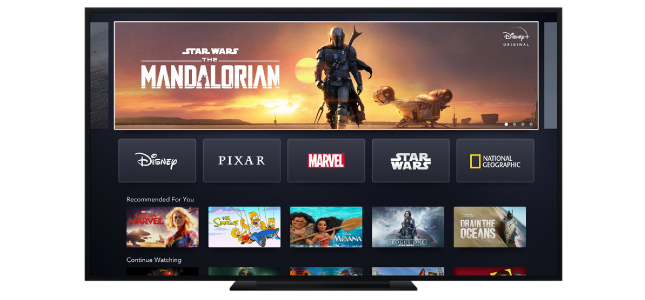
On Nov. 12th Disney Plus entered the streaming world and effectively started the Streaming Wars. Amassing 10 million users on day one and possibly matching Netflix’s 60 million in the future, if this were Game of Thrones, Disney Plus is Daenerys coming to claim her throne.
And soon more services will battle for the streaming kingdom. NBC’s Peacock launch in April 2020 will undoubtedly rock Netflix and Hulu with its reclamation of The Office and Brooklyn 99. Following on its heels, HBO Max is set to go live in spring 2020.
In a recent New York Times article on the state of streaming, Brett Sappington, an analyst and researcher at Parks Associates said, “The truth is that it is only getting started.”
So, what does Disney Plus’s grand entrance mean for customer experience? As existing and upcoming streaming platforms fight for dominance let’s pull in some top customer experience lessons from Disney’s first week.
1. Embrace what customers love about your brand
Disney Plus took a leap of faith into streaming by relying on a brand that has constructed itself to be synonymous with magic, wonder, and creativity in entertainment. What the streaming service has done best so far is its ability to gather and capitalize on intellectual property that has built meaningful experiences for several generations.
While Netflix and Hulu have had to build up their own generated content over the years, Disney is entering the game with a brand that is already interwoven in its own lore and a vault full of content. It’s quite the head start.
CX lesson: As more brands enter the digitally focused direct to consumer marketplace, older organizations may not be as savvy as digitally native startups. But many have already built strong customer relationships and have strong reputations based on company values that if effectively translated online can help transition effective customer experience and loyalty from offline to online.
2. Match personalization with simplicity
True to most streaming platforms, Disney Plus offers many categories of movies and TV shows for users to choose from. There’s something for everyone. Such a wide library of content helped boost the popularity of Netflix and Hulu.
But where once Netflix captivated users with incredibly diverse suggestions ranging from Korean dramas to British cooking shows in one scroll, it quickly became confusing to navigate and cluttered. Forgoing the use of a familiar design, the company instead favored an algorithm that constantly changes your offerings. It has turned into personalization run rampant.
Disney seems to be going for the minimalistic approach to personalization. Offering a finite set of categories, ranging in simple names such as Marvel, Musicals, or Throwbacks. It’s easy to navigate while still giving users the sense of choice.
This may in part be due to the younger demographic that will be using the service. But the decluttered user interface is a welcome change.
CX lesson: The user experience matters. And less is more with your web design. While personalization is a key feature for many products, do not let it overcloud how a user may naturally interact with your brand. Make product and service navigation seamless and easy instead of being flashy. Eliminate friction in finding what to watch.
3. Build customer trust
Trust is an invaluable asset for customers. This can be built off the great experiences users have with products and associates, creating lasting memories of a positive interaction. But trust can just as easily be lost and it can be harder to gain. Findings from Accenture showed a $180 billion drop in revenue from companies who experienced major drops in trust.
Just a week in, Disney Plus already has a damaging situation on hand. On Nov. 16 ZDNet reported that thousands of Disney Plus accounts were hacked and are on sale on black web forums, with the possibility of malicious activity starting right at launch. Add to the fact that the service crashed on its launch day, and the company is faced with its first streaming crisis.
In a statement provided to Enterprise Times Disney stated, “We have found no evidence of a security breach. Billions of usernames and passwords leaked from previous breaches at other companies, pre-dating the launch of Disney Plus, are being sold on the web. “
So while Disney is not claiming direct responsibility for hackings, this needs to be an opportunity for to act swiftly and genuinely with customers to maintain authenticity and trust.
CX lesson: Hackings, leaks, and malware are a common occurrences in the digital age. Use these stressful moments to educate customers (non-condescendingly) on proper password and authentication usage to prevent further incidents. And when issues arise, apologize, be accountable, fix them, and be transparent about what’s happening. Otherwise customers will see right through the PR spin and their trust will erode.
CX will determine the future of streaming
With a name like Disney, the brand is going to have some advantages over other companies. Few companies have such a foundation in the entertainment industry. But a strong history does not ensure that its future is perfectly secure.
Besides reputation and product, customer relationships are often determined by the quality of the service experience. And Disney’s volume of millions of customer service requests and complaints since it launched has been a trial by fire for its customer service team. The company’s Disney + Help Twitter page reported that customer responses are “overwhelming” and “exceeded our expectations” with many Twitter using the platform to voice their concerns and displeasure. Leading up to the new year and beyond, Disney Plus customer service may have reinvent itself to deal with increasingly rampant number of issues.
Rather than rest on its laurels or lean into its content only, Disney Plus and others will succeed with a great product, but more importantly by delivering amazing customer experiences and proactively assisting those in need. And its experience may serve as a lesson in CX for other streaming services coming after it.
Tell a Story With IoT
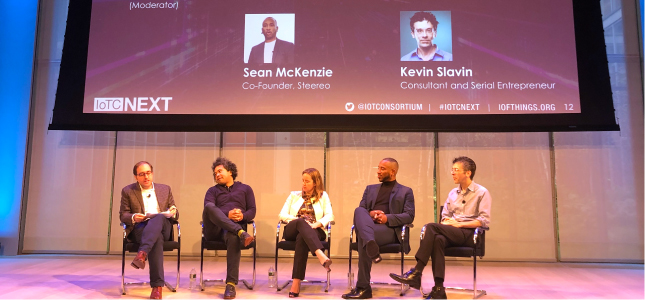
IoT (Internet of Things) devices, products that are connected to multiple channels (think Google Home or any smart home device), are redefining how consumers interact with technology, just look at the UK baby whose first word was Alexa. The recent Connected Future Summit gathered experts and pioneers in this field to contemplate a world that is becoming more connected.
Where is IoT now?
The appeal of IoT devices is how it can streamline many simple tasks, like turning off the lights or playing the news, into only a few devices. Rachel Schwartz, head of business strategy at Bose, cited the sense of control, communication, and access of information as huge incentives for users to jump on board. And consumer adoption is growing—1 in 4 homes have smart speakers to compared to almost none five years ago. But they are not without their own problems.
When pondering the state of IoT, Greg Kahn, president and CEO of Internet of Things Consortium, didn’t wear rose colored glasses. Throwing out a baseball analogy, he said, “We are at the top of the second inning.” IoT still has a long way to go.
“IoT is growing more slowly than it was predicted in 2015,” echoed Bretty May, COO and GM of McKinsey & Co. He cited an executive survey that found 90 percent of respondents are actively participating in IoT initiatives, but only a third have deployed past the pilot phase.
Many of the speakers said that users are facing a huge educational gap on how to use their devices apart from the original intent of purpose (i.e. using your Alexa as a speaker or ordering products). This is coupled with a sense of mistrust of how these devices may use data or invade user privacy. Recent research from the Internet Society revealed that 75 percent of people are concerned about the way IoT devices will use their data without their permission. Meanwhile, 63 percent find data collection creepy.
It is time to be more human
The consensus amongst some of the top companies at the conference, ranging from Google to Bose, was that organizations need to create more experiential moments with their products for consumers. Essentially, give customers (and clearly explain) the opportunities to experience firsthand how these connected devices can improve their lives.
David Wertheimer, former president of digital products at Fox, stated, “we are doing a great job of moving the product,” but customers need to understand the value proposition to engage with them more. “Many industries have this issue of trying to broadcast messages to people and not treat them as individuals [with] their particular needs and issues.”
Companies need to listen and speak to their customers on a more authentic level. Mark Spates, product lead for smart speakers at Google, said brands need to do a better job of explaining the value proposition of smart devices to users and tell stories on how they can impact their lives, like how smart devices are a great approach to monitoring your baby or your child’s internet usage.
The many voices of IoT
Ultimately, it’s the consumer in the end that decides the IoT winners, added Derrick Dicoi, vice president of strategy and product management at Xfinity Home for Comcast. Product sales, customer adoption and long-term retention will be the best metrics of success.
Kathryn Harrison, founder of DeepTrust Alliance, wanted everyone in attendance to consider how IoT technology will affect everyday life. “Look at things not just as the tech but the portfolio of experiences we need in order to consume them,” she says.
Every year will feature a slicker and more promising IoT device. But if organizations do not get the experience right, users will continue to use these devices in a limited, less trusting way.
Capture the Moment: A Data-Driven Strategy

As consumers, we live in a golden age. It has never been easier to find, purchase, watch, or listen to what we want, when we want it. These are the “I want [fill in the blank] moments” where consumers are looking for information, entertainment, assistance, or something else. These moments matter to brands because this is when decisions are being made and preferences are being set—moments when brands need to deliver the right experience at the right time.
But which moments are the most impactful and how can brands identify and capitalize on those instances? With so many touchpoints in the customer lifecycle, it’s difficult to know what to focus on. This is why a data insights strategy is vital to measuring, understanding, and ultimately winning the moments that matter.
Win the Moments that Matter
Consider these two examples: Years ago a colleague of mine purchased a new sofa. Several months later, the store called her to ask if she was pleased with it. She was surprised and delighted with the follow up and told many friends about the experience, even though the purchase happened some time ago. She appreciated that the store still cared about her months after making the sale.
Meanwhile, another friend told me about the difficulty she had returning a product. She had a bad customer experience, one where her expectations were not met, and that experience colored her beliefs about the product and the brand that made it. She thought it should be easy to return the product but it wasn’t.
For brands to win moments that matter, they must make them personally relevant and exceed expectations. I once worked at a company where employees could praise their colleagues by filling out recognition cards with the person’s name and the reason that they deserved recognition. This is a common practice, but what was uncommon is that the head of the company would personally deliver the recognition cards and thank employees for their hard work. To this day, I recall the thrill of watching the CEO walk around the floor and stop at people’s desks. This act of thanks engendered a lot of employee goodwill and staff retention.
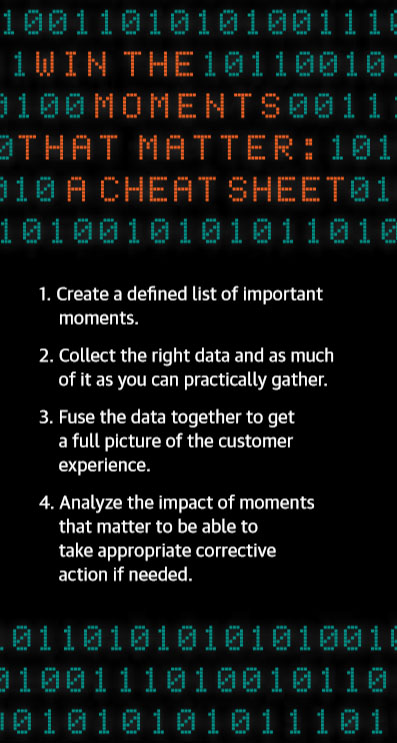
So how do businesses measure how much benefit is gained from having the CEO personally thank employees, or from other moments that matter? It is a four-step process, and much of it centers around data. First, focus on a defined list of moments that matter. Second, collect the right data and as much of it as you can practically gather. Third, fuse the data together to get a full picture of the customer experience. Finally, analyze the impact of moments that matter to take appropriate corrective action if needed.
Define the Moments to Measure
There are many potential moments that matter across the customer lifecycle, and it is easy to become overwhelmed. For companies with a customer journey map, this is the ideal place to start. Select moments to measure based on their importance and your ability to capture data around them.
If you do not have a customer journey map, consider grouping your customers into these six stages, described by KPMG Nunwood, and determine which are the most important to measure first:
- Wooing: This early stage is when the foundation of a relationship is laid.
- Purchase: A key moment that matters, this is when promises are made and expectations are set.
- Honeymoon: At this point, right after the purchase, the customer and business alike are looking to reinforce the decisions they made to be in this relationship.
- Forming: This is when the customer and company are figuring out the best way to work together.
- Storming: Once the honeymoon ends, reality takes hold. Problems can arise and need to be resolved quickly to maintain the relationship.
- Norming: In this stage, standards are set and agreements are made outlining how the relationship between brand and consumer will work.
Collect and Fuse the Right Data
To accurately measure moments that matter, companies need a range of data about their customers to develop a comprehensive understanding of who they are, what they have purchased, how they interact and engage with the company, and their attitudes toward the brand. Data should be as diverse as possible—but be wary that large gaps in data will provide, at best, an incomplete picture and, at worst, a misleading one.
When researching and evaluating data to include, consider:
- Demographics (or firmographic data for B2B companies).
- Purchase history (both online and in-store).
- Loyalty program data.
- Omnichannel engagement, such as app usage, browsing behavior, email engagement, and social interactions.
- Customer feedback, including structured feedback like surveys, as well as unstructured feedback like calls to the contact center or social media posts.
- Customers’ emotions and attitudes about the brand.
To get value from this data, companies need to fuse the various data sources. It is particularly important to integrate customers’ online and offline activity. Much of consumers’ product research and shopping happens online.In addition, they engage with a brand and provide valuable feedback digitally. Remember, people are omnichannel, so data needs to be omnichannel too. Some online data may be difficult to integrate, but identity matching can help link some online and offline behaviors.
Analyze the Impact
Next, brands need to identify the outcome metric or success metric they want to measure, such as revenue or additional products purchased. But for some industries, it could be unlikely that a customer will make another purchase if the customer is early in the lifecycle. In that case, keeping the customer engaged until they are ready to buy again can be an outcome measure.
Once an outcome metric is established, measure how interactions impact the desired behavior. For example, measure the additional revenue or return visits generated with a positive experience versus a negative one during a moment that matters. The difference is the impact of a positive experience over a negative one. It may be that a single, poor experience causes some consumers to switch to a competitor, but it is not necessarily so. There are other mitigating factors such as convenience, habit, or loyalty that will keep customers returning despite a bad experience.
For example, we have found that loyal customers are likely to return to a brand, despite having a bad experience. Unlike new customers, they view a bad experience within the context of all the other experiences they have had with a brand and recognize that bad experience as an aberration rather than the norm. New customers don’t have that history to draw upon. Regardless, it is important to resolve a bad customer experience quickly, as customers will be more willing to come back if their problem was resolved satisfactorily.
Knowing the impact of a good experience over bad, brands can wisely allocate dollars and work on resolving poor experiences during the moments that matter. Plus, armed with detailed data about both the consumer and their experience, companies can provide a remedy that is tailored to the situation and the individual. In some cases, a heartfelt sorry is enough and in others, goodwill in the form of a coupon or discount is required.
One caveat: Those remedies need to be personally relevant but not creepy. Consumers provide data with the expectation that it will be used wisely and not intrusively. Providing a remedy that makes the consumer feel unsettled or uncomfortable defeats the purpose. Companies have to walk a fine line—offering a personalized experience without crossing over to invasiveness. Plus, data might be wrong; a colleague of mine recently checked her profile that a third-party data aggregator had compiled and found some glaring errors. The resolution of a bad experience should leave the consumer feeling satisfied and restore their positive view of the company.
Automation and AI are Making Contact Centers More Human

Contact centers are undergoing a digital transformation that reimagines customer engagement—but don’t count humans out. At ICMI Contact Center Connections, industry experts laid out the many ways that digital technology augments, rather than replaces, human associates. Here are the critical ways that technology can help companies be more human.
An IVR evolution
If one were to believe various publications, voice channels and contact center associates have been eradicated by chatbots. “The Phone Call is Dead,” declared TechCrunch. “Implementing chatbots is all but a must in most industries,” stated VentureBeat. Research firms also support these assertions: By 2020 customers will manage 85 percent of their relationship with an enterprise without interacting with a human, predicts Gartner.
It’s true that customers don’t want to wait several minutes to speak with a human or navigate an outdated interactive voice response system (IVR). Customers want a fast and easy way to solve their problems. But automated solutions provide limited support and customers still prefer human communication for certain interactions, such as tense and emotional issues.
Which is why voice channels aren’t going anywhere, noted Rebecca Roemen, senior consultant of CX strategy and operations at TTEC and an ICMI Movers & Shakers honoree. “Voice is not dying—it’s changing,” she said. Roemen outlined the various technologies and capabilities that are improving voice in the contact center, such as voice biometrics, conversational IVR, natural language processing, and sentiment behavioral analytics. So, instead of trapping customers in a never-ending loop, IVR systems should simply ask, “how can we help you today?” and route customers quickly and accurately.
Voice channels such as IVR are evolving to be more efficient, personalized, and part of the broader customer experience via the Internet of Things, Roemen explained. While even advanced IVR systems aren’t a set-it-and-forget-it solution (they still need regular testing and monitoring), expect leading companies to usher in a more conversational experience.
Live chat: Beware of unforced errors
There are many things to love about supporting customers over live chat. If executed properly, associates can provide support to several customers at nearly the same time on different platforms and devices, and customers receive answers faster than other channels.
However, companies are undermining themselves with poor chat practices, said Leslie O’Flahavan, co-founder and partner at E-Write. “The quality [of live chat] should be better than it is right now, but companies are creating pointless hurdles at the start,” she said.
Those hurdles include being deceptive about wait times, asking customers for a lot of information before initiating a chat, giving overly scripted responses, and failing to train employees on how to interact with customers over chat.
“Chat is like written phone,” O’Flahavan said. As such, there are best practices that associates can borrow from other channels, like voice and email. To help associates deliver quality support over chat, O’Flahavan suggested using both open and closed questions to probe for more information, utilize links and visuals, and match the customer’s level of formality. And most important, “if you can’t staff the channel, take it down.”
As business leaders focus their attention on growth, understanding customers’ needs and expectations, developing strong customer relationships, and driving loyalty are business imperatives. And the companies that deliver smarter customer support in the contact center will have a significant competitive advantage on every front.