
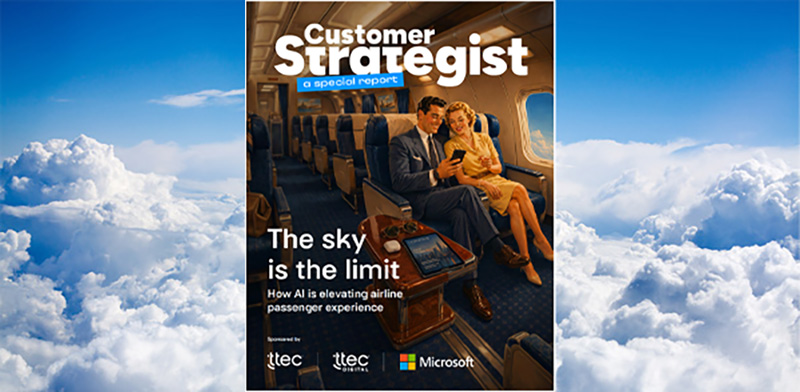
From the Editors of Customer Strategist Journal
Sponsored by TTEC and Microsoft
The airline passenger experience has become digital, data-rich, and deeply automated — and airlines are racing to meet that reality.
Leading carriers are deploying AI across the full customer journey: machine learning to personalize recommendations and predict delays, dynamic rebooking systems to protect tight connections, real-time translation to break down language barriers, and virtual assistants to handle high volumes of routine inquiries before they ever reach a human associate. AI is optimizing gate assignments, streamlining baggage tracking from check-in to carousel, and pushing real-time travel updates directly to passengers’ hands.
Yet even as adoption accelerates, a paradox is taking shape at the heart of this transformation. Passengers may be embracing biometric boarding and AI-powered apps — but they remain skeptical of AI itself. Trust is fragile. And for airlines, that fragility carries real strategic weight.
The brands succeeding today are deploying AI behind familiar interfaces, maintaining clear escalation paths to human associates, and relentlessly focused on removing friction. They understand that the best travel experiences often don’t feel like technology at all.
That balance — between innovation and trust, automation and humanity — is exactly what this new report explores.
In “How AI is elevating the airline passenger experience,” sponsored by TTEC and Microsoft, we examine what it takes for airlines to meet this moment.
Inside, you’ll find:
- The state of passenger experience — Where airlines stand today, and where AI can genuinely take them
- Why AI alone can’t improve the airline passenger experience — The limits of automation and the continued centrality of human connection
- AI-powered associates take flight — How intelligent tools are elevating frontline performance, not replacing it
- The invisible upgrade — Why the best travel experiences don’t feel like technology